
Colocation services
Colocation services let you rent room in a data center run by somebody else to house servers you own.
At list price, a quarter rack starts at $330 a month and a full rack costs $930 to $999. One rack unit, 1U, is 1.75 in tall, and remote hands help runs $100 to $200 an hour.
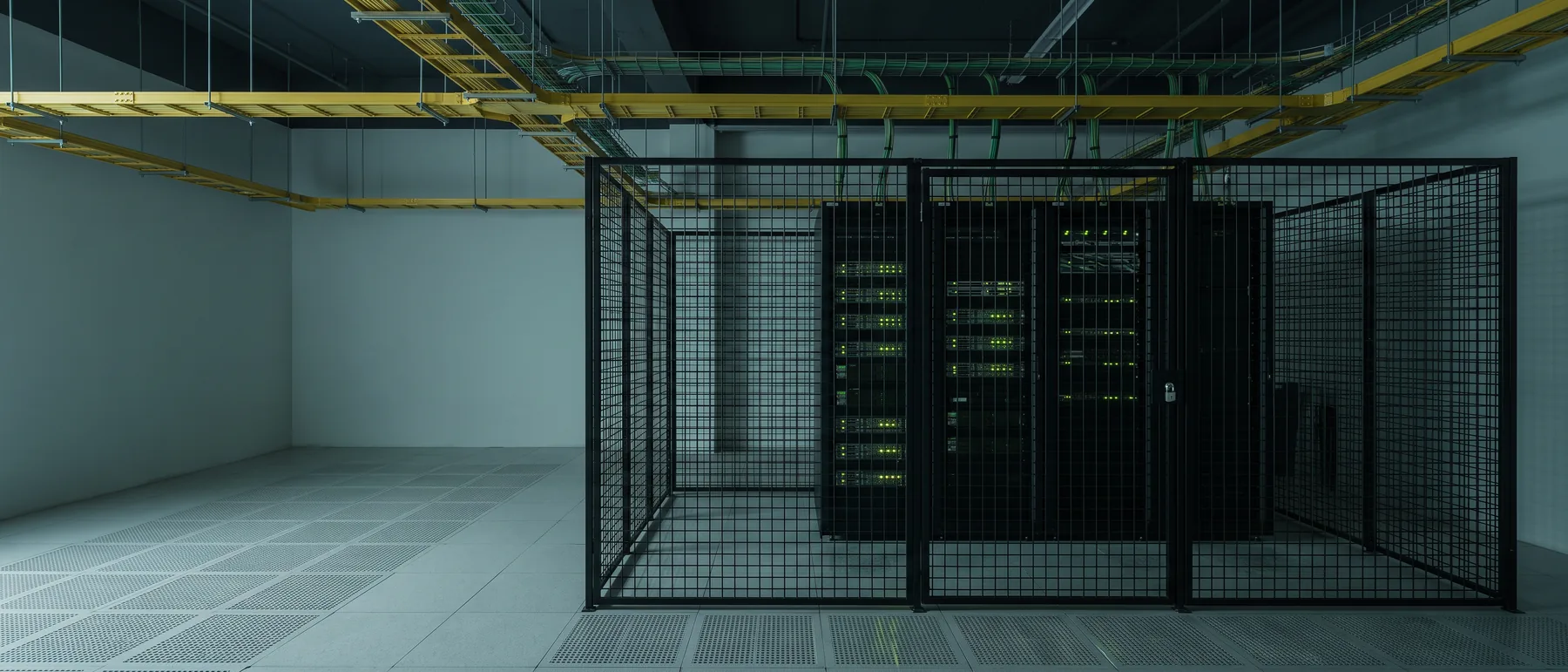
The machines stay yours, and you stay in charge of them, while the operator handles the building itself along with power, cooling and physical security. Tenants in the building split the cost of power, cooling, internet capacity and security.
What you get with colocation
Your equipment lives in a rack. That's a tall metal frame built to hold machines stacked on top of each other, and you can rent anything from a slice of one up to a locked cage or a suite just for you.
The facility itself is built to keep hardware running. If the main power fails, battery backup kicks in, air or liquid cooling removes the heat, and the site is protected from fire and flood. Lockable cabinets and cages let you control who reaches your equipment and keep it separate.
Most contracts commit the operator to keeping the site available almost 100% of the time. You'll find that figure in the service agreement, so check the exact number before signing.
Retail colocation, wholesale or managed
The right pick depends on how much equipment you have and how much help you need, as Megaport explains:
- Retail: a partial rack, a full rack or a larger space, and the most common choice
- Wholesale: large amounts of space and power at prices below retail
- Managed: colocation bundled with extras like monitoring, backups and software updates
If you want that help, ask what services are included when you compare offers.
Providers also group customers by how much power their equipment uses. A kW (kilowatt) is a unit of electric power, and a megawatt is 1,000 kW. Retail covers up to 250 kW, wholesale covers 250 kW to 4 megawatts, and hyperscale, the size of the biggest cloud companies, starts at 4 megawatts. A few servers use only a small part of that, so they count as retail.
What a rack costs
Each month you're paying for four parts: space, power, connectivity and services. Every rack package comes with a set amount of power included, and the numbers below are rough monthly figures in US dollars.
| Space | Price | Included power |
|---|---|---|
| Up to four servers | $69–$199 | 0.24 kW |
| Quarter rack, 10 slots | $330–$399 | 0.6 kW |
| Half rack, 21 slots | $530–$699 | 1.2 kW |
| Full rack, 42 slots | $930–$999 | 2.4 kW |
How these estimates are worked out
Our estimates start from a published rack package price and add the cost of any extra power at the market rent in that city, as tracked by CBRE, a commercial property firm. CBRE's rents come from large deals of 250 kW and up, so we use them to price extra power on a single rack. As a check, Vendr reports that Equinix charges $150 to $300 a month for each kW above a cabinet's allowance, and the CBRE rents fall inside that range. Across the 16 markets CBRE follows, market rents sit between $155 and $275 per kW each month. The priciest top rate, $275, belongs to Silicon Valley; Central Washington, Seattle and Denver tie for the cheapest entry point, $155.
The rack costs in the next table are estimates built from list prices and market rents, so your own quotes may differ.
| Market | Rent per kW | Full rack, 5–10 kW | Full rack, 10–20 kW |
|---|---|---|---|
| Northern Virginia, New York Tri-State, Charlotte-Raleigh | $190–$235 | $1,420–$2,790 | $2,370–$5,140 |
| Atlanta | $185–$200 | $1,410–$2,520 | $2,340–$4,520 |
| Dallas-Fort Worth, Austin-San Antonio | $160–$185 | $1,350–$2,410 | $2,150–$4,260 |
| Phoenix | $175–$215 | $1,390–$2,630 | $2,260–$4,780 |
| Chicago | $195–$225 | $1,440–$2,710 | $2,410–$4,960 |
| Silicon Valley | $200–$275 | $1,450–$3,090 | $2,450–$5,840 |
| Hillsboro, Oregon | $185–$225 | $1,410–$2,710 | $2,340–$4,960 |
| Central Washington, Seattle, Denver | $155–$175 | $1,330–$2,330 | $2,110–$4,080 |
| Houston | $165–$195 | $1,360–$2,480 | $2,180–$4,430 |
| Southern California | $175–$250 | $1,390–$2,900 | $2,260–$5,400 |
| Minneapolis | $165–$175 | $1,360–$2,330 | $2,180–$4,080 |
Enter your space, power and city and the price tool figures out a monthly range for that setup.
Services add to the bill. Remote hands is the name for on-site staff who work on your servers when you can't be there, and that help usually runs $100 to $200 an hour. Any quote can fall outside these ranges, so ask for quotes at no charge, and up to three providers or brokers in your city will email you their prices directly.
Server rack sizes and rack unit height chart
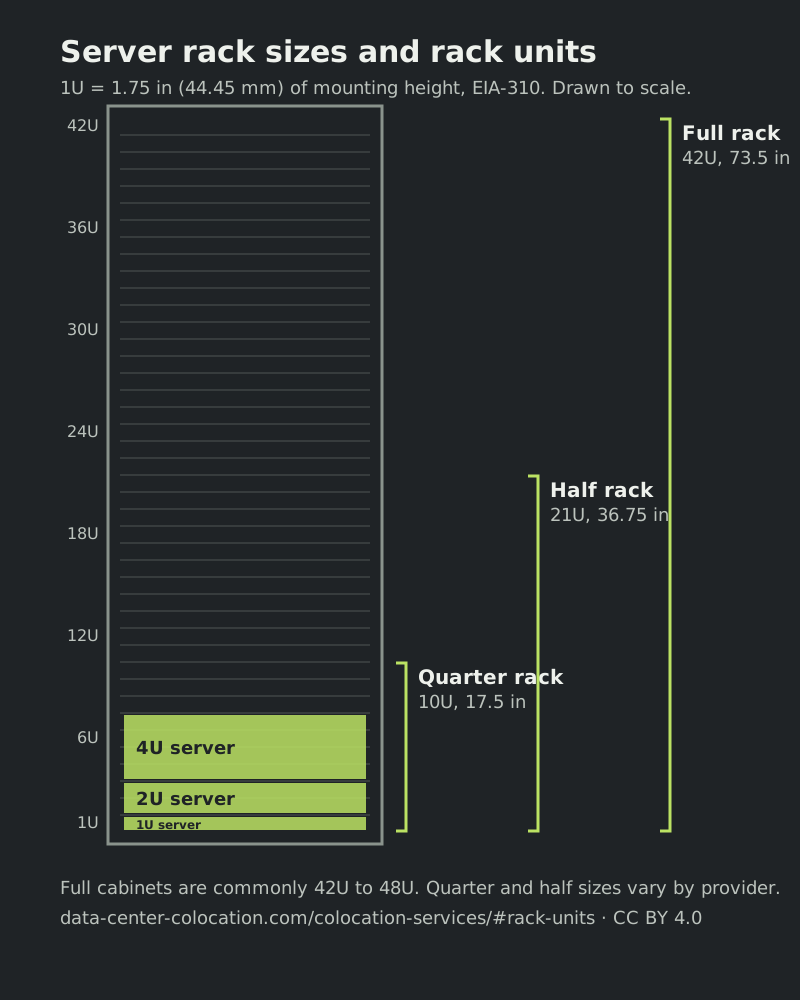
Rack space is measured in rack units, written U. One rack unit (1U) is 1.75 in (44.45 mm) tall under the EIA-310 rack standard, and a full cabinet usually holds 42U to 48U. Quarter and half racks differ by provider, so the sizes here come from published colocation packages.
Rack unit heights
| Rack units | Inches | Millimeters |
|---|---|---|
| 1U | 1.75 | 44.45 |
| 2U | 3.5 | 88.9 |
| 3U | 5.25 | 133.35 |
| 4U | 7 | 177.8 |
| 6U | 10.5 | 266.7 |
| 8U | 14 | 355.6 |
| 10U | 17.5 | 444.5 |
| 12U | 21 | 533.4 |
| 21U | 36.75 | 933.45 |
| 24U | 42 | 1,066.8 |
| 42U | 73.5 | 1,866.9 |
| 45U | 78.75 | 2,000.25 |
| 47U | 82.25 | 2,089.15 |
| 48U | 84 | 2,133.6 |
Cabinet sizes
With cabinet colocation you rent a whole locked cabinet. Most are 42U, and taller 45U to 48U cabinets fit more equipment on the same floor.
| Cabinet | Rack units | Common widths | Common depths |
|---|---|---|---|
| Standard cabinet | 42U | 600 or 800 mm | 1000 or 1200 mm |
| Tall cabinet | 45U | 600 or 800 mm | 1000 or 1200 mm |
| Tall cabinet | 47U | 600 or 800 mm | 1000 or 1200 mm |
| Tall cabinet | 48U | 600 or 800 mm | 1000 or 1200 mm |
Outside cabinet height depends on the manufacturer, so check the product specifications before you plan your room.
Published package examples from two providers
These are a small set of published examples: the quarter, half and full rack packages and the 1U and 4U plans for single servers that Sectorlink and Colocation America list. The market ranges above show what racks with more power cost in each city.
| Size | Package | Rack units | Provider | Power included | Price a month |
|---|---|---|---|---|---|
| Single server | 1U colocation space | 1U |  Sectorlink | 0.24 kW | $69 |
| Single server | 1U colocation | 1U |  Colocation America | 0.24 kW | $75 |
| Single server | 4U colocation space | 4U | Sectorlink | 0.24 kW | $99 |
| Single server | 4U colocation | 4U | Colocation America | 0.36 kW | $199 |
| Quarter rack | 1/4 rack colocation space | 10U | Sectorlink | 0.6 kW | $330 |
| Quarter rack | 1/4 rack | 10U | Colocation America | 0.6 kW | $399 |
| Half rack | 1/2 rack colocation space | 21U | Sectorlink | 1.2 kW | $530 |
| Half rack | 1/2 rack | about 21U | Colocation America | 2.4 kW | $699 |
| Full rack | Full rack colocation space | 42U | Sectorlink | 2.4 kW | $930 |
| Full rack | Full rack | about 42U | Colocation America | 2.4 kW | $999 |
Colocation America lists its half and full racks by fraction, not by rack units, so "about" marks the usual size of that fraction.
Power per rack
| Circuit | Common plug | Nominal kVA | Usable at 80% |
|---|---|---|---|
| 120 V 20 A | NEMA 5-20 / L5-20 | 2.4 | 1.92 |
| 120 V 30 A | NEMA L5-30 | 3.6 | 2.88 |
| 208 V 20 A | NEMA L6-20 | 4.16 | 3.33 |
| 208 V 30 A single-phase | NEMA L6-30 | 6.24 | 4.99 |
| 208 V 30 A three-phase | NEMA L21-30 | 10.81 | 8.65 |
The usable column is 80% of each circuit's rating, the usual safety rule for equipment that runs all day. For most servers, kVA and kW are about the same. Your provider and an electrician confirm the real circuit.
Many racks get two power feeds, A and B, so one can take over if the other fails. Plan as if you have just one, since the second is a backup, not extra power.
As a rough guide, a rack that uses under 5 kW is light, 5 to 10 kW is medium and 10 to 20 kW is heavy. Racks of GPU servers, which run on the chips built for AI work, often need 20 to 40 kW or more. The colocation pricing calculator turns your power into a monthly cost.
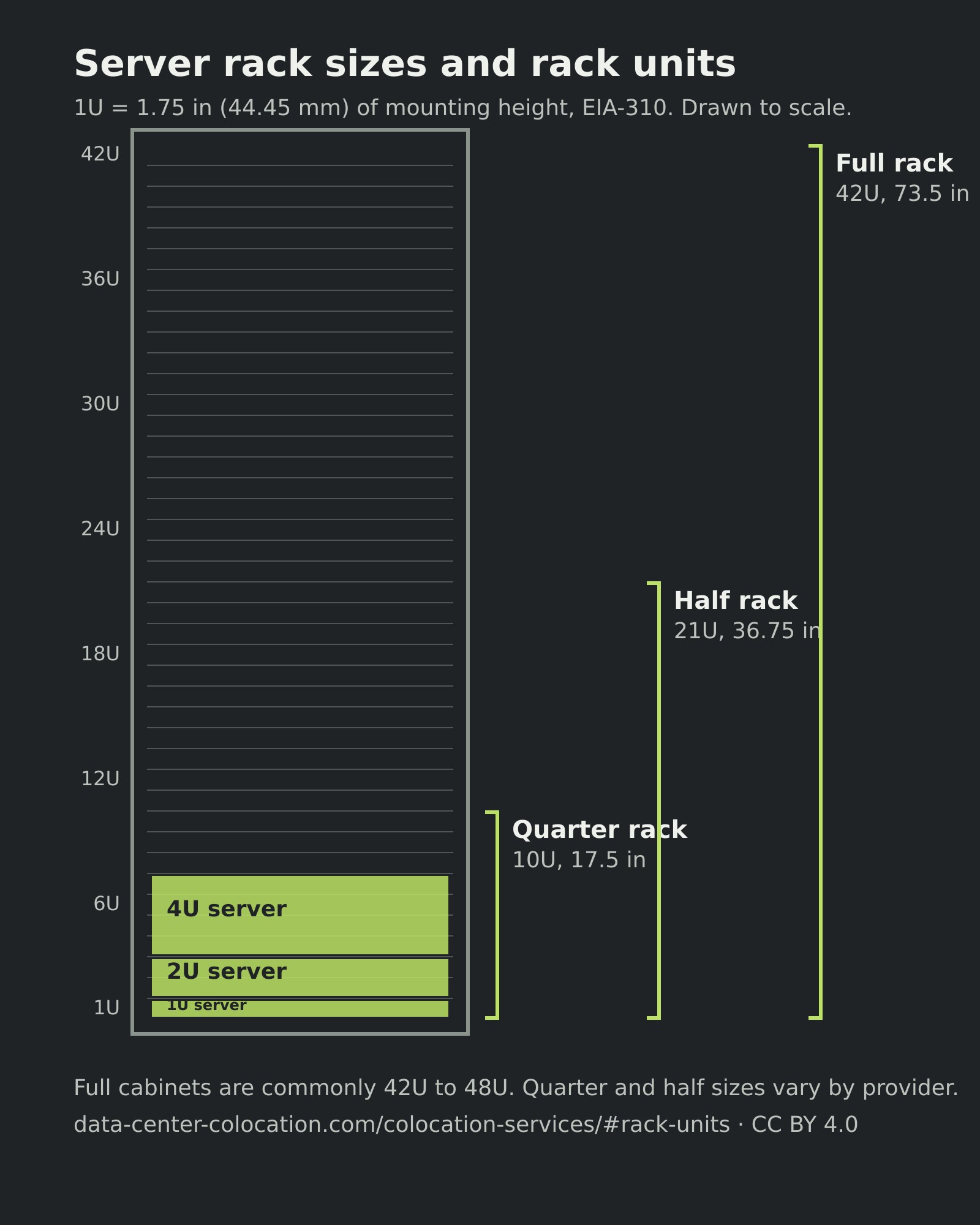
We made this rack chart. Anyone may copy or adapt it under the CC BY 4.0 license, as long as they credit this page with a link back to it. Provider package rows are the providers' own facts and stay with their sources.
Why does carrier neutral matter?
A carrier neutral building hosts many network companies, called carriers, so you can switch your internet or network provider without moving your server. If a provider raises prices or your needs change, you can move freely, since you're not locked into whatever network the building owner sells.
You reach a network through a cross connect, a cable inside the building that links your rack to that network's equipment. Each cross connect costs $150 to $300 a month, so it's worth asking how many your setup would need.
The more networks a building hosts, the more options you get. PeeringDB, a public list of networks and the buildings they use, puts these buildings ahead on network count: Equinix DC1 through DC15 plus DC21 and DC22 in Ashburn (523 networks across that campus listing); Equinix's Miami site MI1 (336); its Chicago buildings CH1, CH2 and CH4 (335 across the three); CoreSite's LA1 One Wilshire in Los Angeles (335); and Hurricane Electric's Fremont 2 site (303).
Being close to your users
Edge computing means placing servers close to the people who use them, to cut the wait between a question and the reply. Distance makes that wait longer, which is why companies put gear in colocation sites close to the people using it instead of one faraway central site.
So when you compare offers, think about the city as carefully as the price.
Questions people ask
How do colocation data centers and hyperscale differ?
It mostly comes down to size. Retail colocation covers up to 250 kW, wholesale runs from 250 kW to 4 megawatts, and hyperscale starts at 4 megawatts, far beyond what a handful of servers needs.
Who owns colocation data centers?
A colocation provider runs the data center, while you keep ownership and control of your servers. Our city listings name the operators of 1,086 colocation buildings across 48 cities, 40 in the US and 8 in Canada.
Where can I find colocation services nearby?
Begin with the city. New York leads with 92 buildings, then Ashburn at 80, Chicago at 68, Dallas at 58, Silicon Valley at 56, Los Angeles at 49, Toronto at 46 and Atlanta at 42, per PeeringDB. Every city has a page listing its buildings along with the operator, networks and street address.