
GPU colocation
With GPU colocation, the servers belong to you and you rent room for them inside a data center.
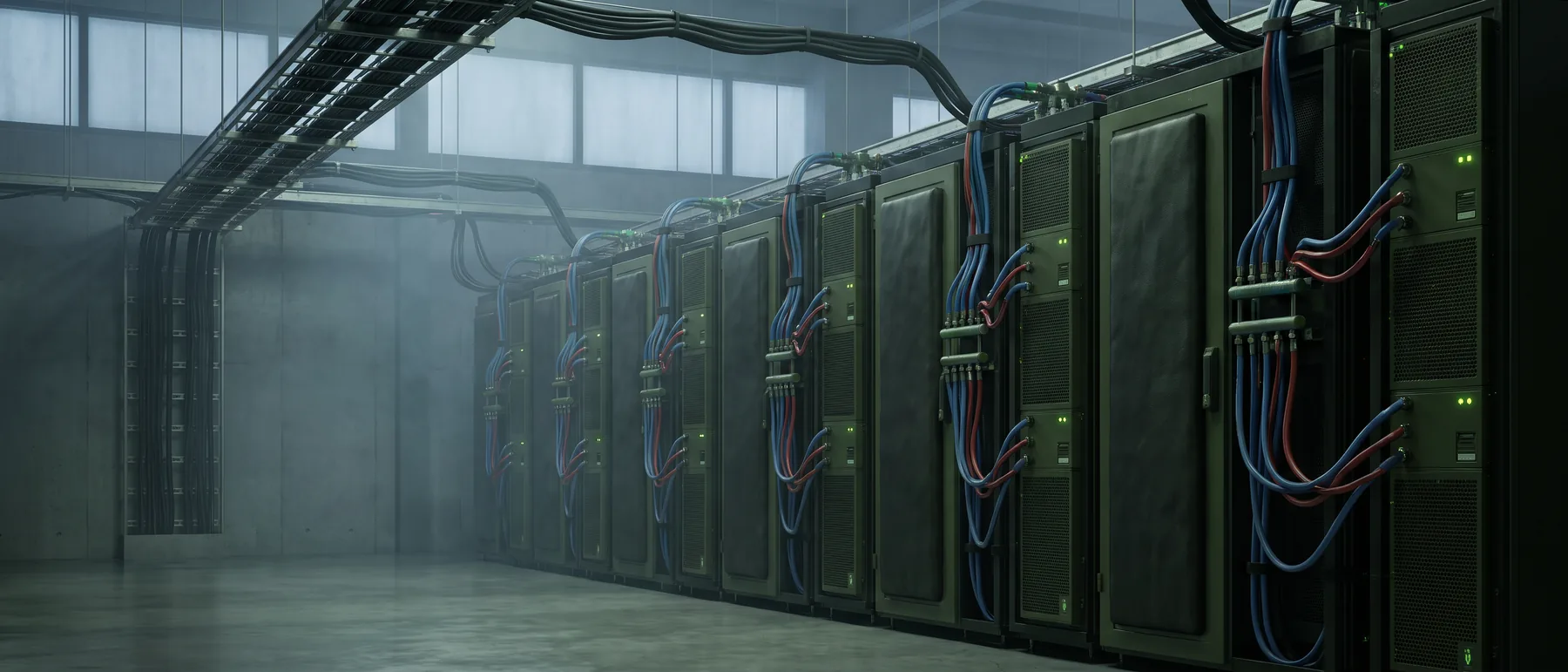
What you pay for is the space they take up plus the power and cooling they need. For GPU hardware, power and cooling count for much more than floor space, so those two factors shape both which buildings can host you and what you'll end up paying.
What power draw should you plan for in a rack?
Your equipment lives in a rack, the tall metal frame data centers use to stack machines. Rack power gets measured in kilowatts, or kW, and one kW is just a thousand watts.
According to datacenterHawk, modern facilities support 30 to 50 kW per rack today, with designs allowing for 100 kW or more in the future. Before you request quotes, it helps to have a rough idea of what your own hardware will draw.
High density colocation
Some buildings can deliver far more power to one cabinet than the standard 30 to 50 kW. Flexential advertises cabinets rated at 150 kW and above, several times the draw of a typical rack today.
Every kilowatt you push into a rack turns into heat that has to leave the building. For AI workloads, liquid cooling, which moves heat out through a fluid rather than fanning air over the servers, is now considered essential, per datacenterHawk. If your racks will run hot, bring this up with each provider early, because cooling that much power is something not every building can do.
Cooling choices for GPU servers
TRG Datacenters gives GPU customers three cooling options:
- Air, the old standard approach
- Immersion, which bathes the servers in a dedicated liquid
- Direct to chip, which pumps liquid through plates attached to the chips
The right pick depends on your rack power draw and on what your server manufacturer supports, so ask about this before signing anything.
How is power billed?
Every provider bills power their own way, and that choice moves your monthly total. TRG offers an all-in rate for clients using less than 100 kW and metered power for larger requirements.
In Texas, TRG says metered power for GPU blocks of 100 kW and up has averaged about 6 cents per kilowatt-hour over three years. That is the same unit your home electric bill uses.
A fixed monthly bill appeals to some GPU owners. LightEdge describes one client who gave up paying by the second for a fixed monthly cost based on power, space and cooling.
What does GPU colocation cost from city to city?
Full rack packages you'll see advertised cost $930 to $999 a month, but they bundle in only around 2.4 kW of power, well under what GPU servers actually draw. The power on top of that is where the real money goes, and our price tool estimates it from CBRE's asking rents for each market. These monthly figures are estimates, not market prices. CBRE's rents apply to deals of 250 kW and up, and our tool uses them as a guide to the cost of extra power for one rack. Vendr reports that Equinix charges $150 to $300 per kW a month above a cabinet's power allowance, a range that brackets the CBRE figures.
| Market | Monthly rent for each kW | One full rack, 20 to 40 kW (GPU servers) | Fenced area, 100 to 250 kW |
|---|---|---|---|
| Northern Virginia | $190–$235 | $4,270–$9,840 | $19,000–$58,750 |
| Chicago | $195–$225 | $4,360–$9,460 | $19,500–$56,250 |
| Silicon Valley | $200–$275 | $4,450–$11,340 | $20,000–$68,750 |
| Phoenix | $175–$215 | $4,010–$9,080 | $17,500–$53,750 |
| Dallas-Fort Worth | $160–$185 | $3,750–$7,960 | $16,000–$46,250 |
| Houston | $165–$195 | $3,830–$8,330 | $16,500–$48,750 |
| Seattle | $155–$175 | $3,660–$7,580 | $15,500–$43,750 |
Looking across all 16 CBRE markets, rents land somewhere between $155 and $275 for each kW in a month. The biggest top figure, $275, belongs to Silicon Valley, while Central Washington, Seattle and Denver tie for the lowest floor at $155.
Getting power switched on
Where the space is already built, TRG says small and medium GPU needs up to 500 kW can have power turned on within days to a few weeks. Keep in mind that's just the electricity being ready, not your machines being set up and running.
To ask for quotes, you complete one form covering space, power, city, timing and contract length, plus an optional note. Sending your request is passed along to as many as 3 providers or brokers with room in that city, and they email you their prices directly. Asking costs nothing.
Common questions
Why is colocation so expensive?
For GPU servers, most of the bill is power rather than space, so every kilowatt above what a package includes adds to the monthly cost. Denver, with 13.8% of its space open, is among the cheapest markets, paying just $155 to $175 for each kW in a month.
Does Houston have colocation?
Yes. About 5.0% of Houston's space sits empty, and a rack pulling 5 to 10 kW in that market would run roughly $1,360 to $2,480 per month by our estimate. From PeeringDB, our Houston page pulls every colocation facility in town, along with each building's operator, its networks, its internet exchanges and its address.
Which providers are largest?
Across the 48 metros we cover, PeeringDB counts buildings as follows: Digital Realty tops the list at 68, then Equinix and DataBank at 60 each, Cologix at 38, Centersquare at 37, Flexential at 36, Lumen at 33, CoreSite at 28, Cogent at 25 and EdgeConneX at 23. These counts measure the size of each operator's footprint, not whether their buildings can cool GPU racks.
Where do my old servers go when I replace them?
Whether it's a few retired machines, storage drives, network equipment or an entire room full of gear, you can ask for a price through the same site. That request reaches up to 3 IT asset disposal firms, and they reply with a price along with the certificates they issue.